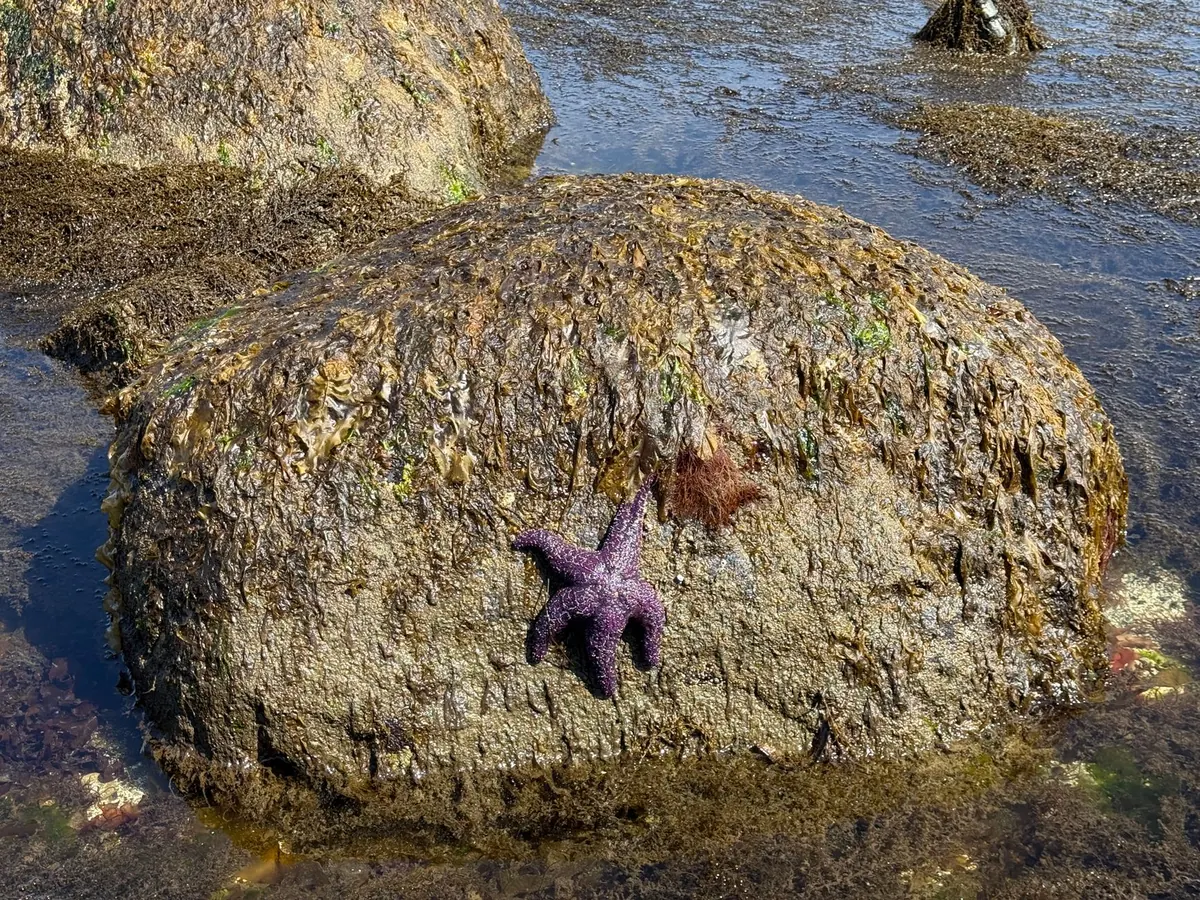
Half an hour either side of low tide, the British coast turns itself inside out. Flat, dark rock that looked like nothing much an hour ago becomes a scatter of small pools, and every one of them is busy: shellfish clamped to the walls, fish sulking in the corners, weed swaying, and something red and squashy that looks suspiciously like a blob of jam. You don't need a boat, a wetsuit or any expensive kit to see it. Wellies, a tide table and five minutes of standing still will do.
What follows are the residents you are most likely to meet on a rocky shore anywhere in the UK, and the habits that keep them there for the next person.
When and Where to Look
Rock pooling is a timing game. The pools high up the shore are only topped up by the biggest tides, so they dry out and get baked, and the life in them is tough but sparse. The good stuff sits lower down, near the low water mark, where the sea has only just left. Check a tide table before you go, aim to arrive as the water is pulling back, and remember that spring tides — the largest of the month, around the new and full moon — expose more shore than anything else.
Any rocky beach will do, but look at the structure rather than the view. Gullies, overhangs, the shaded side of boulders and the space between clumps of weed all hold more than a flat, sunlit slab. On the west and south-west coasts the variety tends to be greater, but limpets, beadlet anemones and shore crabs turn up almost everywhere.
A short kit list:
- Wellies or shoes with real grip on wet weed
- A shallow white tray or clear tub — a pale background makes small animals far easier to see
- A hand lens, or the macro setting on a phone
- A tide table, printed or on your phone
- A warm layer. You will stand still for longer than you expect
Apply sun cream at home rather than on the shore. Residues on your hands end up in the water, and they are not kind to marine life.
Limpets, Barnacles and the Grazers
The common limpet is the cone-shaped shell you will find clamped to almost every rock. It is not stuck by suction alone; the animal grinds its shell to fit one particular patch of rock, its “home scar”, and returns to it after each feeding trip. Knock one and it clamps down hard. Prise one off and you have probably killed it, because it will struggle to reseal against the rock.
Barnacles look like tiny grey volcanoes and are not molluscs at all but crustaceans, glued in head-first and feeding by waving feathery legs through the water when the tide covers them. Winkles graze the weed — flat winkles on the weed itself, common winkles on the rock — and if you find a patterned, cone-shaped shell with a pearly inside, that is a topshell. Lower down, dog whelks drill neat round holes into mussels and barnacles.
Anemones: The Flowers of the Pool
Out of water, the beadlet anemone is a dark red or olive blob, which is exactly what it looks like: a blob of jam. Submerged, it opens into a ring of tentacles, often with blue tips. It is the commonest anemone on British shores and it manages fine in a shallow pool that dries for an hour or two.
The snakelocks anemone is longer, brighter and greener, with purple-tipped tentacles it cannot fully retract, so it flops rather than shrinks. You will see it most often in the south and west. Dahlia anemones, patterned and sturdier, sit lower down the shore.
Anemones are relatives of jellyfish and carry stinging cells, used to catch small prey. Some people feel a faint tingle from a snakelocks; others feel nothing. Either way, look rather than poke. An anemone pulled from its rock tears its base and rarely survives it.
Crabs: Five Pairs of Legs and an Attitude
The shore crab is the one you will meet most. Look for a broad, slightly pointed shell, green, olive or reddish, usually under weed or half-buried in gravel. Hermit crabs walk about in borrowed whelk or periwinkle shells, and you will often see one claw and a pair of antennae poking out. The velvet swimming crab, further down the shore, is blue-black, velvety, has red eyes and will swim off in a hurry if disturbed.
If you pick a crab up, cup it from behind, over the top of the shell, with a hand underneath to support it. Never lift one by the legs, and give a big velvet swimming crab the respect its claws deserve.
Fish in Pools: Blennies, Gobies and Rocklings
The common blenny, or shanny, is the star of most British pools: mottled brown-green, blunt-headed, big-eyed, often perched on a rock rather than swimming. It can breathe air through its skin, which is why it can sit out a low tide in damp weed. The tompot blenny is bigger and wears small branched tentacles above its eyes; it is a southern and western specialist and a wonderful find.
Gobies are smaller and harder to spot, resting on the bottom on their fins with two separate dorsal fins. Rocklings hide in the weed. All of them react to movement and shadow, so the trick is to stand with the sun behind you, keep your shadow off the water and stay still. Chasing a blenny round a pool achieves nothing except tiredness.
Starfish, Urchins and Their Relatives
The common starfish, orange or pink with five broad arms, turns up in lower pools, where it feeds on mussels by forcing the shell open and pushing its stomach out through its mouth. The cushion star is smaller, with five short, stubby arms, and hides under stones on south-western shores. Brittle stars look like small, frantic spiders and vanish under weed the moment a stone is lifted. Sea urchins, mostly on the west coast, sit in the deepest pools.
Starfish and urchins move on hundreds of tiny tube feet, which grip hard and tear easily. Never pull one off the rock, and if you have lifted a stone to look underneath, put it back the way you found it.
How to Look Without Causing Harm
A rock pool is a small, crowded place, and a few minutes of care makes a real difference. The essentials:
- Turn only small stones, and put each one back exactly as it was, damp side down. Big rocks rarely go back properly and they shelter a great deal of life.
- Wet your hands before touching anything, and keep them free of sun cream and insect repellent.
- Never prise anything off a rock — limpets, barnacles, anemones and starfish are all anchored.
- If you use a tray or tub, keep it shallow and shaded, and return everything to the pool you took it from within a few minutes. A hot afternoon is the worst time to hold animals in a bucket.
- Take nothing living home. Empty shells are fine; photographs are better.
- Leave the weed alone. It is the nursery, the larder and the hiding place.
- Take your litter away, including anything that was not yours.
Two points about your own safety. Rocky shores are slippery, and the sea comes back round a headland faster than it looks; check the tide times, keep half an eye on the water and tell someone where you are going. Barnacle scratches and crab nips can become infected, so cover any cut before you start, and if a scratch turns red, hot or swollen afterwards, speak to a pharmacist or doctor.
Do all that, then sit down beside a pool and wait. The beadlet opens, the blenny edges out of its crevice and the whole thing resets itself around you. Come back on a different tide and you will meet a different cast.
Photo: Ali Vanschie / Pexels