You're paddling at the edge of the water on a bright afternoon when a hot wire of pain shoots up from the sole of your foot. Or you brush against something soft and trailing in the shallows and a rash blooms across your forearm. Most of the creatures that sting and cut around the British coast are small, well camouflaged and completely uninterested in you. Knowing which ones matter, where they turn up and what to do in the first ten minutes is what turns a ruined afternoon into a story you tell afterwards.
Jellyfish: Beautiful, Drifting, Occasionally Vicious
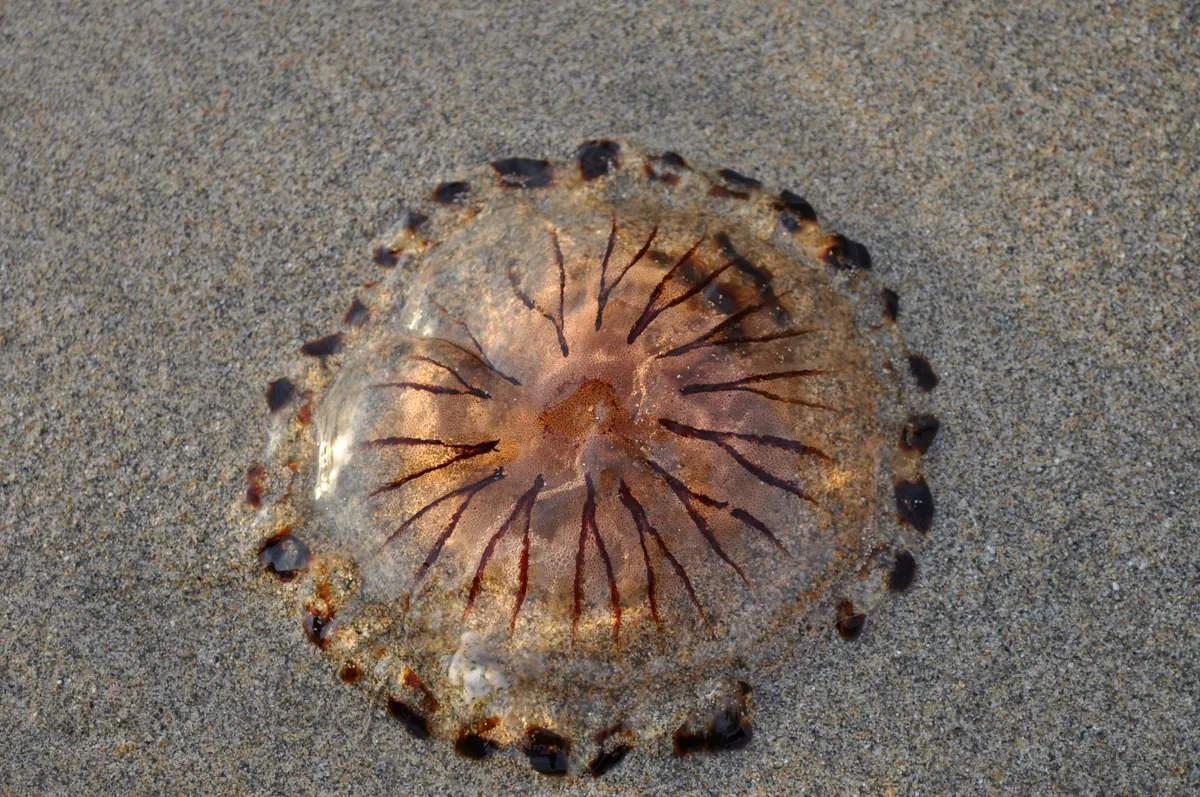
Several species reach UK shores in numbers, mostly between late spring and early autumn. Moon jellyfish are the common translucent discs with four pale rings; they give at best a mild tingle. Compass jellyfish have brown lines radiating across the bell like spokes and can leave a genuinely sore, itchy stripe. Lion's mane jellyfish are large, brownish and frilly with a mass of trailing tentacles, and they're the ones most often responsible for a sting that keeps hurting for days. Mauve stingers are small, deep purple and mostly found offshore in the south-west, though onshore winds can bring them in. Barrel jellyfish look enormous and alarming but are largely harmless.
Blooms build when the water warms, and onshore winds push them onto beaches in drifts. A jellyfish stranded on the sand can still fire its stinging cells hours after it has washed up, so the rule is simple: look, don't touch. Children investigating a shiny blob on the strandline cause most of the stings we see on busy beaches. Wet wetsuits won't protect exposed ankles and wrists, and swimming straight through a bloom is asking for trouble.
First Aid for a Jellyfish Sting
Move quickly, but don't panic. The sting is rarely dangerous in UK waters, though it hurts.
- Get out of the water and stay out. Cold, shock and panicky swimming cause more problems than the sting itself.
- Don't rub the area and don't rinse it with fresh water, which can trigger more stinging cells. Seawater is fine.
- Lift off any visible tentacles with tweezers or a gloved hand — never bare fingers.
- Soak the area in hot water, about as warm as you'd tolerate in a bath, for around twenty minutes. This is the step that eases pain most reliably. Ignore the folklore about urine, sand, razors and alcohol.
- Take paracetamol or ibuprofen for pain if you need it, following the packet.
- Watch for anything beyond local pain and a rash. Stings to the face, eyes or mouth, a large area of skin, difficulty breathing, chest pain or feeling faint mean calling 999.
Vinegar has a place, but a narrow one: it's recommended for Portuguese man o' war, a siphonophore that occasionally turns up on south-western and western coasts. For ordinary UK jellyfish, hot water is the practical answer.
Weever Fish: Small, Buried, and Painful
The lesser weever is a hand-sized fish that buries itself in wet sand in shallow water, usually on sandy beaches in summer, often exactly where people paddle. Its dorsal spines carry venom, and if you stand on one the pain builds fast, peaking within about half an hour. It can be severe enough to make you feel sick, sweaty or faint. Anglers also get stung handling them — the gill covers have spines too.
Get out of the water, sit down and keep the foot still. Soak it in hot water, again around 40°C and as hot as you can comfortably bear, for at least twenty minutes or until the pain settles. Check the wound for a spine. If one is embedded, don't dig around with a needle at the beach — leave it to a nurse or doctor. If the pain keeps escalating, the wound is deep, or you feel unwell beyond the foot, seek medical help: NHS 111 can point you to the right service.
Prevention is almost embarrassingly simple. Shuffle your feet through shallow water rather than stepping, which disturbs buried fish ahead of you, and wear beach shoes or wetsuit boots when paddling. Most stings happen to barefoot children at the water's edge on warm days.
Sea Urchins and Other Prickly Characters
Urchins are a rocky-shore problem rather than a sandy-beach one, and they're more common on the west and north coasts of the UK and Ireland. Their spines snap off under the skin and can stay there for weeks, working their way deeper or turning into an infection. Barnacles, limpets and mussel shells will cut you just as efficiently if you scramble over rocks barefoot.
Remove any spines you can see with tweezers, soak the area in hot water to ease the pain, then clean and cover the wound. Keep an eye on it over the following days: spreading redness, swelling, warmth or pus needs a professional look. Get help sooner if a spine is deep, near a joint, in the sole of the foot or palm of the hand, or if you simply can't get it out. Tell the clinician what happened — spines don't always show up clearly on scans. Puncture wounds from the sea are also worth mentioning to a GP or minor injuries unit if your tetanus cover isn't up to date.
Sea anemones are best left alone too. They aren't a serious hazard, but some people react to touching them, and rockpooling hands are usually the ones that find out.
Prevention: The Boring Bits That Work
- Read the signage at the beach entrance and ask lifeguards what's about — they know what has washed in this week.
- Wear beach shoes or wetsuit boots on rocks and in shallow water, and shuffle rather than step.
- Look before you sit down, put a hand on a rock or pick something up.
- Leave jellyfish alone, including the ones on the sand.
- Keep an eye on children at the water's edge, not just in the water.
- Carry a small kit: tweezers, antiseptic, plasters, a bandage and a bottle of water for rinsing the wound.
- Check the tide times and know how you'd get help — mobile signal is patchy on plenty of coves.
When to Get Help
Call 999 if someone has difficulty breathing, swelling of the face, lips or throat, chest pain or collapses after a sting — that suggests a serious allergic reaction and needs urgent treatment. Call NHS 111 for advice when you're unsure, or if pain isn't settling after hot water and painkillers. See a GP or minor injuries unit for embedded spines, wounds that won't heal, or any signs of infection in the days afterwards.
Most encounters with British sea life end with a few minutes of swearing and a story. Treat everything you can't identify as something to look at rather than touch, and the coast stays what it should be: the best place to spend a warm afternoon. This is general guidance rather than medical advice, so if you're worried about a sting, a cut or an allergic reaction, speak to a healthcare professional.
Photo: Pexels User / Pexels